Vivid Emptiness
About Sad-dharma Temple in Jiangsu
Xinghua Fahua Ancient Temple
was initially built in the late Tang Dynasty and is located in Laoge Village, Lincheng Town, Xinghua City, Jiangsu Province, originally known as Fahua Monastery.
In 2003, initiated by local devotees, a hall was renovated from an old supply and marketing cooperative building on the original site of Fahua Monastery, marking the beginning of the restoration and preparation work for the Fahua Ancient Temple. In the same year, with the approval of the Municipal Ethnic and Religious Affairs Bureau, Fahua Monastery became a temporary religious activity site. In 2004, Venerable Qingde was invited by the Municipal Ethnic and Religious Affairs Bureau, the Municipal Buddhist Association, and local devotees to reside here and rebuild the ancient temple. Thanks to the care and support of the religious departments, the Municipal Buddhist Association, and numerous devotees, the Fahua Ancient Temple was officially renamed and approved as a religious activity site in 2007.
Despite not being backed by a famous mountain or a bustling city, the Fahua Ancient Temple strives to uphold its strict rules, gather devotees, and promote the true Dharma. It aims to create a pure land and establish a famous temple, adhering to precepts, keeping a pure heart, cherishing compassion, cultivating a righteous monastic atmosphere, and making its humble contributions.


Main Buildings
Hall of Heavenly Kings
The center of the Hall of Heavenly Kings is enshrined with a seated statue of Maitreya Bodhisattva. Behind the statue of Maitreya Bodhisattva is a statue of the guardian deity Skanda Bodhisattva. Skanda Bodhisattva holds a vajra (a magical weapon to dispel troubles and quell demons), appearing brave and dignified, guarding the entire temple. On both sides of the Hall of Heavenly Kings are statues of the Four Heavenly Kings. According to Buddhism, they guard the four cardinal directions and protect the endless flow of Buddhist dharma.
The Four Heavenly Kings, also known as the Four Guardians of the World, are famous guardians of Buddhism. They are respectively the Dhrtarastra (Eastern King of the Nation Preserver), the Virupaksa (Western King of Broad Eyes), the Vaisravana (Northern King of All Hearing) and the Virudhaka (Southern King of Growth). These four Celestial Gods are different from the Four Great Diamond Guardians of Buddhism, and many people often confuse them. The Four Heavenly Kings are the Four among the Twenty Celestial Gods. They reside in the first of the six heavens of the Desire Realm, also known as Heaven of Four Heavenly Kings. The Buddhism sutras mention that in the middle of Mt. Sumeru, there’s a mountain called Gandhara, which has four peaks in four cardinal direction. Each Heavenly King lives at one peak to guard the relevant cardinal direction of the World (Four Continents in Buddhism, namely the East Continent - Purvavideha; the South Continent - Jambudvipa; the West Continent - Aparagodaniya; the North Continent - Uttarakuru). So they are also known as the Four Guardian Heavenly Kings, the first of the six heavens of the Desire Realm.
The Four Heavenly Kings are usually enshrined on the two sides of the first hall in temples of Pure land School and Chan School. Hence, this first hall is accordingly called Heavenly Kings Hall.
Main Buildings
Stone Statue of Ksitigarbha Bodhisattva
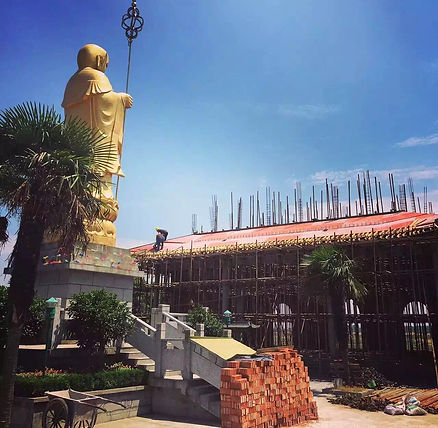
In the center of the open square front of the Pilu Precious Hall stands a stone statue of Ksitigarbha Bodhisattva. This statue shows the standing figure of a Bhikshu, holding a tin staff in his right hand and a Mani pearl in his left. The overall demeanor is serene, the face is dignified, and the expression and form are extremely vivid. The total height of the statue is close to 10 meters, which can be regarded as a landmark building of the Fahua Ancient Temple.


Main Buildings
Pilu Precious Hall
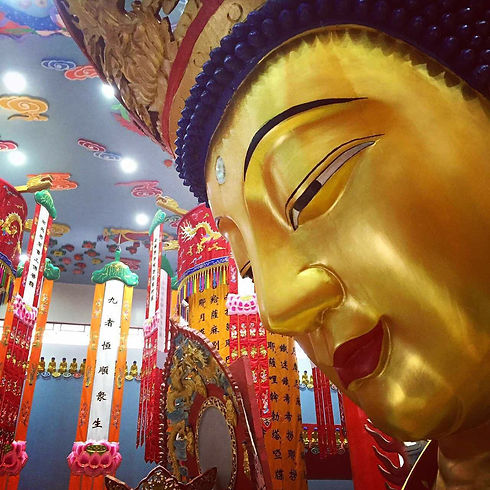
The Pilu Precious Hall (originally named the Brightest Hall), an ancient and solemn two-story palace-style building in the Song Dynasty style, is the main building in the temple. In the center of the hall is enshrined Vairocana Buddha, flanked by Samantabhadra Bodhisattva and Manjusri Bodhisattva.
These Buddha statues are about 3 meters high and are covered with gold foil, making the entire hall filled with golden light and appearing extremely dignified and solemn. Instead of the traditional eighteen arhats, the hall features statues of the Twenty-Four Devas on both sides. They stand at a fifteen-degree forward angle, expressing deep respect for the Buddha. These devas include Brahma, Indra, Vaiśravaṇa, Dhrtarastra, Virocana, Virudhaka, Vajrapani, Maheshvara, Sanzhi General, Saraswati, Lakshmi, Skanda, Prthivi, Bodhi Tree Deity, Hariti, Marici, Sun Palace Deity, Moon Palace Deity, Sagara Naga, Yama, Kinnara, Ziwei Emperor, Mount Tai Deity, and Lei Zu Deity. Behind Vairocana Buddha is a giant colored statue of Guan Yin on an island.
Guan Yin stands on the head of a giant turtle, surrounded by many Sudhana children who are undergoing the "Fifty-Three Visits" (studying Buddhism from 53 people with Buddhist knowledge and wisdom) and receiving the enlightenment from Guan Yin Bodhisattva.
Abbot Introduction
-
Venerable Zhaoxia, Tang Dynasty, unknown details
-
Venerable Xueqing, Song Dynasty, unknown details
-
Venerable Langhui, Qing Dynasty, unknown details
-
Venerable Ruoxu, Republic of China, unknown details
-
Venerable Shi Qingde, from 2005 to present
History
The Fahua Ancient Temple in Lincheng Town, Xinghua City is bustled with pilgrims and devotees, its halls echoing with Buddhist chants. The temple, adorned with intricate carvings and paintings, attracted visitors from far and wide, making it a vibrant and sacred destination. However, during the Japanese invasion of China, both the ancient Lingting town and this millennium-old temple were reduced to ashes by the invaders.
When Venerable Shi Qingde was invited to preside over the temple, he found it in ruins, the once sacred Buddhist ground destroyed by war. Deeply saddened, Qingde vowed to revitalize Buddhism, rebuild the ancient temple, propagate Buddhist teachings, and save all sentient beings.
Year 2005

In January 2005, Venerable Shi Qingde presided over the work of Fahua Ancient Temple.
In June 2005, the Xinghua Municipal Government earnestly implemented the Party's religious policies and restored Fahua Ancient Temple as a venue for Buddhist activities.
Year 2006-2007
In April 2006, the Ancestor Hall was completed. In December 2007, the foundation of the Brightest Hall was completed.
Year 2008
In January 2008, under the correct leadership of leaders at all levels such as the Municipal Ethnic and Religious Affairs Bureau and the support of many believers in Shanghai and other places, the Brightest Hall was completed.
In April 2008, a plaque was hung in the Brightest Hall. In December 2008, the statue of Dainichi Nyorai Buddha was welcomed.
Year 2009-2010
In January 2009, with the care and help of the Xinghua Municipal Government, the "Completion Ceremony of the Brightest Hall of Fahua Ancient Temple and the Buddha Statue Consecration Ceremony" was held at the temple.
In April 2009, the statue of Island Guan Yin Buddha was welcomed. In November 2010, construction began on the Hall of Heavenly Kings. In November 2010, the open-air Ksitigarbha Buddha statue began to take shape.
Year 2010

In November 2010, the Dutian Hall was under construction. In December 2010, the gilding of the open-air Ksitigarbha Buddha statue was completed.
Year 2011
In February 2011, the Dutian Hall was basically completed.
In April 2011, the "Completion Ceremony of the Dutian Great Hall of Fahua Ancient Temple and the Deity Statue Consecration Ceremony" was held at the temple.
Year 2013
In June 2013, the temple built a river plaza platform.
Year 2014
In December 2014, the Brightest Hall was renovated and the interior decoration was completed, and it was renamed the Pilu Precious Hall.
Year 2015
On August 3, 2015, the beams of the Hall of Heavenly King were raised.
In August 2015, the Wuguan Hall was under construction.
In August 2015, the Fahua Ancient Temple Charity Group was established, launching the "Daily Good Deed" public charity event to promote charity through daily good deeds.
On November 6, 2015, the beams of the Wuguan Hall were raised.
Year 2016
In October 2016, the Xinghua Fahua Ancient Temple Charity Association was established.
Charity Association
In August 2015, the Temple Management Committee of Xinghua Fahua Ancient Temple established a charity group and launched the "Daily Good Deed" public charity event, promoting charity through daily good deeds and carrying forward the spirit of benevolence and kindness. With one yuan per day and one good deed per day, the event encourages uninterrupted good deeds and accumulation of virtues. Under the leadership of Abbot Shi Qingde, the "Daily Good Deed" charity event at Xinghua Fahua Ancient Temple has gradually received attention and support from various sectors of society and kind-hearted people at home and abroad. With the donations collected, several public charity events have been carried out, gradually developing into a systematic and standardized public welfare organization.
In October 2016, under the guidance and care of the Xinghua Buddhist Association and the Xinghua Ethnic and Religious Affairs Bureau, the Xinghua Fahua Ancient Temple Charity Association was established. The Charity Association carries out charity activities through projects such as protecting the Three Treasures (Buddha, Dharma, and Sangha), environmental protection, medical assistance, educational support, and poverty alleviation for the elderly. This is a charity team that serves the community and dedicates love, practicing humanistic Buddhism based on the concept of benefiting all sentient beings like a bodhisattva.
"Daily Good Deed" is often used to encourage people to be kind. According to the book "Ancient Mirrors of Moral Education" edited during the Qing Dynasty, the idiom "Daily Good Deed" originated from Ge Fan, who served as the chief clerk of the Ordnance Department during the third year of Zhezong Yuanyou in the Song Dynasty. Ge Fan insisted on doing good deeds every day and later became a prefect. When someone asked him how to perform a "Daily Good Deed", he said, "For example, if there is a bench here that has fallen and is blocking people's way, just bend down and put it upright, which is a good deed." A family that accumulates goodness will surely have blessings, and when a thought of kindness arises, everything will be auspicious. It is a traditional Chinese virtue to care for the elderly and the young as we care for our own, which should be carried forward. We should start by caring for those around us, using our meager strength to care for vulnerable groups in society and make them feel warm. Let love be passed on and integrated with love.
We sincerely welcome every kind-hearted person to join us. All donation details will be registered by a dedicated person, and the collected cash donations will be deposited into a dedicated account. We will use your donated funds to carry out charity projects such as poverty alleviation, education assistance, disaster relief, and disability assistance, using your love to help lonely elderly people, out-of-school orphans, patients who cannot afford medical treatment, and low-income families who cannot afford to live. Your kindness will ignite their inner hope for life.
Although no one can see the accumulation of virtues, Heaven knows the good deeds one has done.
When people do good, although happiness may not come immediately, misfortune has already stayed away;
When people do evil, although misfortune may not come immediately, happiness has already stayed away.